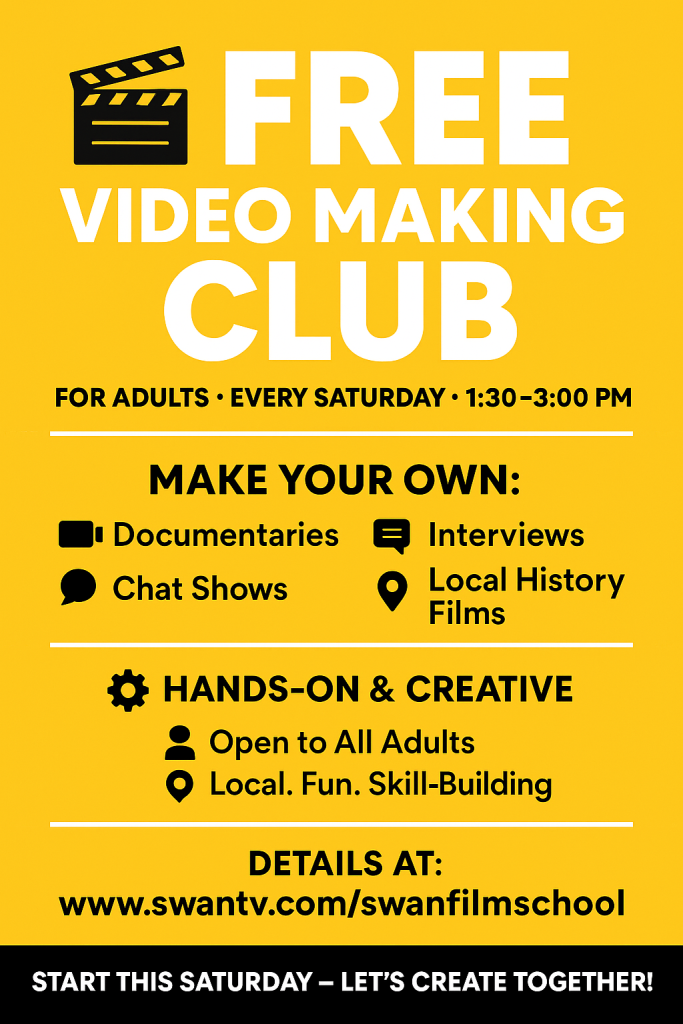
Every Saturday from 1.30 to 3pm (during school vacations 1.00 to 2.30pm) there is an adult film making group meeting to learn the art of video making through a sociable practical guidance. It’s free, so come along. Let us know you are coming by text or whatsapping 07964 827959. We look forward to meeting you.
Making a documentary is a creative and collaborative process that combines research, storytelling, and visual media to share real-life stories with an audience. Whether you are working alone, with a small group or a community project, a structured approach will help you create a film that is both engaging and meaningful.
- Define Your Story and Purpose
Every good documentary starts with a clear idea. Begin by brainstorming alone or in the group, getting everyone to contribute where possible. What story do you want to tell, and why? Your subject could be a person, a place, an event, or a wider social issue. Decide who your audience is and what you want them to take away from the film. Once you have a topic, write a short “logline”—a one or two sentence summary of your film—and choose a working title. - Research and Plan
Good documentaries are built on strong research. Collect background information about your topic, and if relevant, look for archival photographs, videos, or documents. Make a list of people you could interview—these might include experts, community members, or those with personal stories connected to your subject. Draft a set of open-ended questions that will help interviewees share their experiences in detail. At this stage, it’s also useful to outline the shape of your film: how will it begin, what journey will it take the audience on, and how will it end? If practical go and visit any relevant places and contact the list of people you have. Outline your documentary and what you want from them such as specific information so that they can be prepared. They may have their own material they can bring to the interview. - Organise Your Team and Equipment
If you are working alone it is best to do a dry run before you leave your bae so you personally know everything works and you are fully familiar with the equipment. In a group project, assigning roles keeps things running smoothly. Common roles include a director (who oversees the creative vision), a producer (who organises schedules and permissions), camera and sound operators, researchers, editors, and presenters. In small teams, people can take on more than one role. Issue a checklinst and CheckIssue a checklist with what equipment you need—cameras, microphones, tripods, lighting—and make sure everything is working before you start filming. Charge everything and have a supply of spare batteries. - Filming
When filming interviews, choose a quiet location with good lighting. Natural lighting is best: cameras today can adjust to most natural and indoor lighting. The interviewer can stand alongside the camera and ask questions so the interviewee is not looking directly at the camera: or you can have the interviewee looking directly at the camera but this is often uncomfortable for them. Frame your subject nicely in the shot and test your audio before starting. Always carry a mirror in case they want to fix their hair, straighten their clothes or check their make-up. Put them at ease with some light talk beforehand and tell them It’s just a conversation between two people and forget the camera. Remember they are dong you a favour. Encourage them to answer questions in full sentences and allow space for follow-up questions to get deeper answers. Close-up shots are good, especially if the camera is zooming in as it’s not so intimidating. Alongside interviews, capture plenty of “b-roll”—extra footage that adds context, such as shots of locations, people at work, or relevant objects. These visuals help bring your story to life. Thank the interviewees after filming and tell them what will happen and where they can view the film. - Editing
After filming, organise your footage clearly so it’s easy to work with. Start by making a rough cut, piecing together interviews and key visuals in a logical order. Add in b-roll, archival images, and sound effects to make the film more dynamic. Background music and narration can also help guide the viewer, but make sure any music used is copyright-free. Review the film with your group, gather feedback, and refine it until you are happy with the final version. - Share Your Documentary
Once finished, export your film in a suitable format, usually MP4. Add titles and credits for everyone who contributed. Finally, plan how to share it— the Swan Film School will show your film on Swan TV and also arrange a showing for friends and family. Its useful to use social media to promote your film and we will enter suitable films at film festivals.
A well-made documentary tells a story that informs, inspires, and stays with its audience. With planning, teamwork, and creativity, you or your group can produce a film to be proud of.
Remember with the Swan Film School you will learn the art of video production at every stage in a practical fun way.